

Four Technology Trends Shaping the Future of Vietnam

In the era of powerful digitalization, Vietnam is transforming into a regional technology hub, serving not only as an assembly site but also as the cradle for many "Make in Vietnam" initiatives. Data has become the core driving force, reshaping how we live, work, and do business. Currently, prominent technology trends in Vietnam focus on applying Artificial Intelligence (AI), promoting domestic innovation, upgrading smart consumer devices, and strengthening its position in the global electronics supply chain.

1. Artificial Intelligence and Data Science: The Key to Transformation

Artificial intelligence (AI) and Data Science (DS) have become core driving forces in predicting market trends and optimizing production processes. The potential of AI/DS is limitless when it comes to making smart, data-driven decisions.

However, this field also faces numerous challenges, as statistics show that 80% of AI projects fail right from the initial problem definition stage. The causes of failure often stem from unclear objective setting or the lack of a structured approach for implementation. Therefore, Logical thingking and Problem-Solving Skills are core and indispensable capabilities for transforming raw data into real business value.

with a systematic approach. AI/DS professionals need to apply the 7-step process framework with a systematic approach, which includes defining the problem clearly using the 5W1H technique and finding the root cause through the 5 Whys method. Setting objectives must adhere to the SMART (Specific, Measurable, Achievable, Relevant, Time-bound) to ensure actionability and sustainable value.

Công nghệ mới và Ứng dụng: Trong lĩnh vực thị giác máy tính, Image Segmentation (phân vùng ảnh) is an important task. To solve complex problems that require high levels of detail, deep learning methods utilize kiến trúc mạng U-Net đang được ưu tiên. U-Net, với thiết kế đối xứng gồm encoder và decoder, lần đầu tiên giới thiệu skip connections in Deep Learning to minimize spatial information loss during the downsampling process. Applications of Segmentation are highly diverse, ranging from segmenting cells in medicine to detecting roads and vehicles in autonomous driving.

2. Driving the "Make in Vietnam" Initiative

The Vietnamese government and business community are actively promoting Science, Technology, Innovation, and Digital Transformation initiatives. The Ministry of Science and Technology has launched The Portal for receiving and publishing science, technology, innovation, and digital transformation products and solutions (Portal 57).

This platform not only publishes typical solutions that have been successfully deployed, but is also a place to honor and spread initiatives and improvements Technical no matter how small, reflecting the spirit of Resolution 57. The Ministry of Science and Technology plays the role of appraising the features and effectiveness of the products in order to connect and promote them to organizations, ministries, and sectors.

Representative Vietnamese enterprises: Vietnam's major technology corporations have demonstrated strong support for this platform:

• Representative FPT stated that Portal 57 is a strategic connecting platform between the Government and the technology business community.

Group Representative CMC commented that this is a practical action to bring Resolution 57 to life.

• Trí Nam Co.op assessed that Portal 57 is a useful environment that helps product owners and those in need find each other easily, quickly, and reliably.

• MISA proposed that the Ministry of Science and Technology add dossier classification criteria to make it more convenient for users to search.

3. Consumer Technology and Smart Home Appliances"

The Vietnamese market is witnessing a boom in smart devices, from home appliances to wearables, meeting the demand for improving the quality of life and sports training.

Smart home appliances and security:

Introduced smart home products include electronic rice cookers, mini projectors Beecube X2 Max Gen 3 Full HD 1080P, and smart electronic scales Eufy C20The Eufy C20 scale is integrated with advanced biometric analysis technology, measuring weight and calculating BMI with an extremely low margin of error (0.05kg), while also capable of analyzing heart rate, bone mass, and visceral fat rate.

• In the field of security, smart surveillance camera products such as Xiaomi IP WiFi 3MP C100 and Tp-Link Tapo C206 2MP attracted a lot of attention. Xiaomi's camera is equipped with AI capable of detecting human movement, minimizing false alarms, and recognizing abnormal sounds (baby crying).

Wearables and Gaming:

• Smartwatch models dedicated to sports are attracting attention, such as Amazfit T-Rex 3 Pro (with an ultra-durable design using a Grade 5 Titanium bezel and sapphire glass, along with a sensor BioTracker 6.0 PPG) và Huawei Watch GT6 46mm (with high-performance dual-band GPS, using HarmonyOS smooth experience and silicon carbon new gen for long-lasting usage).

• In gaming, the trend focuses on speed and lightweight design. An example is the gaming mouse Corsair SABRE v2 PRO Ultralight weighing only 36g, along with the ability to support Polling Rate lên tới 8000Hz and 33,000 DPI sensor

4. Strategic Position in the Global Supply Chain

Vietnam is becoming an important manufacturing and transit hub amid global trade tensions. The world's largest electronics brands, such as Apple, HP, and Dell, are requiring their Asian partners to ramp up production and shipping to air-freight products such as smartphones and laptops to the US to evade tariff strikes. Supply chains have been built in India and Southeast Asia that have been built over many years are now paying off.

with the goal of capital recovery, causing major disruptions. Although large domestic technology enterprises such as However, the US imposing high tariffs on Chinese goods has also raised concerns. Mr. Tran Huu Quyen, Chairman of VNPT Technology, warning about the possibility that Chinese electronic goods could flooding into the Vietnamese market with the goal of capital recovery, causing major disruptions. Although large domestic technology enterprises such as Viettel and VNPT assesses that US tax policies will have almost no direct impact on them; however, they still need early intervention from regulatory authorities to ensure the healthy development of the domestic market.

In summary, Vietnamese technology is developing with a focus on quality, domestic innovation, and the structured application of AI/DS. In tandem, Vietnam's role in the global supply chain is becoming increasingly strategic, demanding flexibility and the capability to respond to international market fluctuations.

Digital Marketing Strategic Plan for Agricultural Enterprises in Vietnam

Digital Marketing Strategic Plan for Agricultural Enterprises in Vietnam
The document presents the digital transformation orientation for Vietnam's agricultural sector in the 4.0 era. Content includes: market analysis, digital branding with 4 core messages (Clean – Fresh – Convenient – Sustainable), multi-channel strategy (Social Media, SEO, Content, E-commerce), along with a 6-step implementation roadmap and a KPI system for performance measurement.

This is a strategic handbook that helps Vietnamese agricultural enterprises develop sustainably and lead the market in the digital era.

In the context of Vietnam's agriculture entering a period of powerful transformation, digital marketing is no longer an option – it is an inevitable path.
The plan from SeaTek not only provides a modern customer acquisition strategy but also serves as a guiding compass to help agricultural enterprises build a strong brand, increase value, and develop sustainably in the digital era.

Algorithms 02 – Link list 

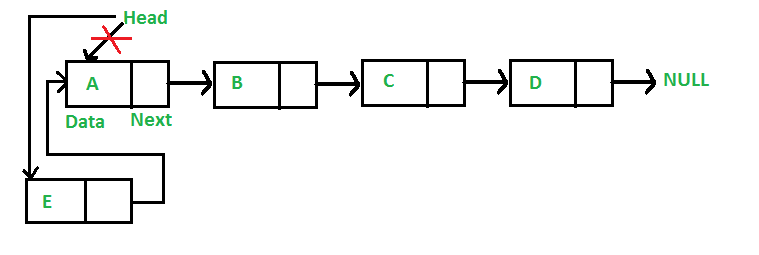
Linked List (Linked list) is one of the structured data frameworks in the installer. It is displayed from a a series of nodes, where each node stores the value (value) and a pointer (pointer) points to the next node in the list. This structure is particularly useful when working with dynamic data or performing frequent insertion and deletion operations.

Note: This article is for beginners. The author shares their self-learning process, hoping to inspire and reinforce knowledge for the community. If you already have experience, continue practicing at a higher level or try rewriting and explaining it – as this is the most effective way to memorize and train algorithmic thinking.

1. Understanding Linked Lists through a visual example.

Imagine Linked List like string ticket trên Jira or Trello – each ticket has a link “Next” leads to the next ticket.

In fact, you'll find linked lists in many places:

  • Function Undo/Redo Excel or VS Code are prime examples of this. Doubly Linked List:
    • Ctrl + Z → go backward (prev)
    • Ctrl + Y → Go to (next)
  • Web browser when you press Back or Forward — that is, you are moving in a Two-way linked list Displays browsing history.

2. Common Types of Linked Lists

Singly Linked List

Each node has only one pointer. next points to the next node.

  • Browse words head → tail But there's no turning back.
  • Advantages: simple, memory-saving, fast insertion or deletion at the beginning of the list (O(1)).
  • Disadvantage: cannot be accessed backward; to find a node previously, you have to traverse from the beginning.
  • Typical exercises: LeetCode 206 – Reverse Linked List.

Doubly Linked List

Each node has both pointers. prev and next, allowing for bidirectional browsing.

  • Browsing is possible in both directions.
  • Inserting/deleting in the middle is more convenient than a single list.
  • It takes extra memory to save. prev.
  • Caution is needed when updating the cursor to avoid incorrect pointing errors.

Circular Linked List

Last node (tail) points back to the first node (head), forming a closed loop.

  • Browsing from any node will traverse the entire list.
  • Application in round-robin scheduling or systems that require continuous loops.
  • A clear stopping condition needs to be defined to avoid infinite loops.

3. Comparing Linked Lists and Arrays

CriteriaArrayLinked List
Access by indexO(1)O(n)
Insert/Delete ElementO(n)O(1) (if there is a pointer)
MemoryFixed allocationMore dynamic and flexible.
ApplicationDB Index, Static ArrayUndo/Redo, Cache, LRU Cache

4. Featured LeetCode exercises

  • 206. Reverse Linked List → Reverse the cursor direction using three variables prevcurrnext.
  • 141. Linked List Cycle → Detect loops using two fast-slow pointers (fast–slow pointers).
  • 21. Merge Two Sorted Lists → Merge the two sorted lists, carefully pointing the pointer correctly.
  • 146. LRU Cache → Combine HashMap (O(1) lookup) and Doubly Linked List (O(1) reorder, delete).

5. Basic Python Code Examples

class Node:
    def __init__(self, val):
        self.val = val
        self.next = None

class LinkedList:
    def __init__(self):
        self.head = None

    def insert_head(self, val):
        node = Node(val)
        node.next = self.head
        self.head = node

    def insert_end(self, val):
        node = Node(val)
        if not self.head:
            self.head = node
            return
        curr = self.head
        while curr.next:
            curr = curr.next
        curr.next = node

    def print_list(self):
        curr = self.head
        while curr:
            print(curr.val, end=" -> ")
            curr = curr.next
        print("None")

6. Effective ways to learn and practice

Before you start coding, please Draw a Linked List diagram on paper.Most errors when working with Linked Lists stem from pointing the wrong cursor.pointer), so be sure to understand the direction of next and prev before running the code.

  • Focus on four groups of exercises: reverse list, detect cycle, merge lists, remove node, and LRU cache.
  • In backend/frontend interviews, you'll often be asked about the trade-off between Arrays and Linked Lists.
  • Prepare templates Node and LinkedList To code faster.
  • Always consider the time/space complexity beforehand to optimize the solution.

7. The mindset for training is important.

When practicing linked lists, start with a short list: [1 → 2 → 3 → None] or [10 → 20 → 30 → 40 → None].

With a short list, it's easy to observe the changes after each operation. insert, delete, reverseIf you encounter a pointing error, printing a small list helps in quick detection. Once your logic is solid, try a larger test case.

Additionally, please write more. helper function like print_list() or to_array() To visualize the data after each step.

8. Conclusion

  • Linked Lists are the foundation of many other data structures such as Stack, Queue, Graph, and Cache.
  • Understanding the nature of pointers is more important than memorizing formulas.
  • Draw – Simulate – Code – Optimize: that's the most effective learning cycle.

Summary: Mastering Linked Lists will give you a deeper understanding of how data operates in memory and expand your thinking to more complex structures like Trees, Graphs, Heaps, and HashMaps. Understanding the fundamentals first, then optimizing – that's the right mindset when learning algorithms.

Algorithms 01: Dynamic Programming on Graphs

This article systemizes the core nature of Dynamic Programming when applied to graph structures. I present it in clear sections to help readers grasp the key focus and approach — especially suitable for beginners or those looking to review the concept.

1. Core Idea

In classical DP problems (e.g., Fibonacci, Knapsack), states usually have a natural order from 1 to n. On graphs, the dependency relationships between nodes do not have a fixed order; therefore, it is necessary to determine an appropriate computation order to ensure that dependencies are satisfied before computing the value of a node.

Topological order is the ordering of vertices in a directed graph such that if a directed edge u → v exists, u appears before v. If the graph is a DAG (Directed Acyclic Graph), we can perform a topological sort and safely use this order for DP. If the graph contains cycles, topological sort is not applicable; in that case, alternative techniques such as DFS combined with memoization or iterative relaxation algorithms like Bellman–Ford / Floyd–Warshall are used until the values converge.

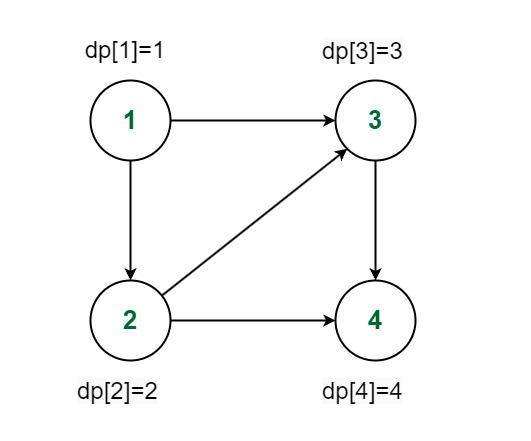
Illustrative example: to compute the value of node 4 (assuming the value is the total path from 1 to 4), we first need the results of nodes 2 and 3; to have 2 and 3, we must have the result of 1. Therefore, it is necessary to arrange the order so that each node is computed after the nodes it depends on.

ex: topo = [1, 2, 3, 4]

dp[1] = base
dp[2] = f(dp[1])
dp[3] = f(dp[1])
dp[4] = f(dp[2], dp[3])

Thus, the computation order always ensures that dependencies already have values.

2. Example: Longest Path on DAG

Problem: Given n vertices and a set of edges, find the length of the longest path on a DAG. Idea: Traverse the vertices in topological order and update the values for adjacent vertices.

For each edge u → v, perform:

dp[v] = max(dp[v], dp[u] + 1)

Pseudo code:

topo = topological_sort(graph)
dp = [0 for _ in range(n)]
for u in topo:
    for v in graph[u]:
        dp[v] = max(dp[v], dp[u] + 1)
return max(dp)

Time complexity: O(V + E) if a topological order is already available. Topo ensures that a vertex is never updated before its prerequisites have been processed.

3. When Graphs Have Cycles

If the graph contains cycles, topological sort is not applicable. Common alternatives include:

  • DFS + memoization: use DFS to compute values on demand, storing results (memo) to avoid recomputation. For problems requiring the longest path on a graph with cycles, cycles must be handled appropriately (e.g., detecting infinity or cutting cycles according to the problem requirements).
  • Bellman–Ford / Floyd–Warshall: iterative algorithms that relax edges multiple times until the values converge (or detect the existence of a negative cycle with Bellman–Ford).

DFS + memo pseudo code:

def dfs(u):
    if seen[u]:
        return dp[u]
    seen[u] = True
    dp[u] = 1 + max(dfs(v) for v in graph[u])
    return dp[u]

Bellman–Ford: iterate through all edges V-1 times, each time performing an update of the form dist[v] = min(dist[v], dist[u] + w). In essence, this is a form of iterative DP (iterative relaxation) until the values stabilize.

4. Real-World Analogy

Real-world dependency management problems accurately reflect the thinking of DP on graphs:

  • Airflow DAG: a task only runs when the tasks it depends on have completed.
  • Compiler dependency graph: module A must be compiled before module B if B depends on A.
  • Neural network forward pass: traverse the computation graph in topological order to compute the values of the nodes.

Ultimately, these are all dependency resolution.

5. Key Takeaways

  • On a DAG, prefer using topo DP with a complexity of O(V + E).
  • If the graph contains cycles, consider using DFS + memoization or iterative relaxation algorithms like Bellman–Ford.
  • The focus is not on formulas; it is on managing information flow (dependencies) and computation order.
  • DP on graphs = reuse + ordering + dependency control.

6. Related LeetCode Problems

For practice, you can refer to the following problems (from easy to medium-hard):

  • 207. Course Schedule — cycle detection + topo sort
  • 210. Course Schedule II — construct topo order
  • 329. Longest Increasing Path in a Matrix — DP on an implicit graph in a grid
  • 1514. Path with Maximum Probability — DP combined with Dijkstra
  • 787. Cheapest Flights Within K Stops — a variant of Bellman–Ford

7. Personal Reflection

I used to understand DP as a rigid set of state transition formulas. After diving deeper, I realized that the essence of DP is managing information flow within a dependency network. Graphs only make the concept more abstract, but the principle remains the same: solve the simple parts first, store the results, and then use them to compute the more complex parts.

Once you grasp this principle, algorithms like Bellman–Ford, Floyd–Warshall, or topo DP become much more intuitive. A useful habit: draw the dependency graph before coding and experiment with a small example (4–5 vertices) to observe the order and how values propagate.

Practical Principles:

  • Understand the computation flow (simulate flow) before implementing code — Understand > Memorize.
  • DP = reuse + ordering + dependency management — from there, you can reconstruct the algorithm without having to memorize formulas.
  • If there are cycles, do not force a topo sort; switch to an iterative update method like Bellman–Ford and continue to relax until stable.
  • Always clearly identify 'who depends on whom' — visualization helps to quickly grasp dependencies.
  • Start from the base case; think forward (past → future) or backward (goal → start) depending on the problem.
  • If you find yourself computing the same value repeatedly — use memoization; double-check boundaries and base cases to avoid common errors.

Ghi chú: Đây là chia sẻ từ góc nhìn người bắt đầu nhằm giúp người học hệ thống lại kiến thức. Việc thực hành và giải nhiều bài sẽ giúp nâng cấp khả năng làm chủ các biến thể nâng cao hơn.

What is WordPress? A complete guide to the world's most popular website building platform

If you have ever thought about making a website for yourself or your business, surely the name WordPress has more or less crossed your mind. This is the most popular Content Management System (CMS) in the world, accounting for over 43% of all websites globally. What makes it so well-loved? Why do both individuals and large corporations choose WordPress to develop their websites?

In this article, we will explore in detail everything from the concept, pros and cons, hosting, and the differences between WordPress.com and WordPress.org, to the types of websites you can build and the most useful plugins.


What is Wordpress

WordPress is an open-source software that allows you to build and manage websites easily. It was first developed in 2003 by Matt Mullenweg and Mike Little. Initially, WordPress was merely a blogging platform. But thanks to its outstanding scalability and flexibility, it quickly transformed into a massive website ecosystem.

Wordpress streng is it's open source. Anyone can download, install, modify, and develop it according to their needs. Along with that, WordPress possesses a massive community where millions of developers and users contribute plugins, themes, documentation, and continuously update it to make the platform more and more perfect.

Today, WordPress is no longer just a blogging tool. You can use it to build almost any type of website: from personal blogs, news websites, forums, and portfolios, to e-commerce sites or online learning platforms.


What is WP hosting

For a website to function, you need hosting — a website hosting service. And specifically for WordPress, there are WordPress Hosting specifically designed for this platform.

Unlike regular hosting, WordPress Hosting has outstanding advantages:

  • Server optimization: Hardware and software configurations are specifically tailored for WordPress to run faster and more stably.
  • Easy to install: Just a single click or automatically pre-installed when initializing the hosting.
  • Auto update: WordPress versions, plugins, and security are always kept up to date.
  • Built-in speed optimization: Built-in cache, CDN, gzip compression, and database optimization.
  • Support: A technical team with deep WordPress expertise, helping to resolve issues quickly.
  • Smart tools: A dedicated dashboard to manage multiple websites simultaneously.

If you want a smooth experience with fewer technical headaches, WordPress Hosting is definitely a choice worth considering.


Pros and cons of WordPress

Like any platform, WordPress has both its strengths and limitations.

Pros

  • Easy to use Beginners can also get used to it quickly, with no programming skills required.
  • Large community: Millions of users, developers, and designers are ready to share experiences, plugins, and themes.
  • Massive plugin & theme library: Free and paid, easily expand features or change the interface.
  • SEO friendly: Plugins like Yoast SEO or Rank Math support search engine optimization extremely effectively.
  • Update continously Always patched for security vulnerabilities and updated with new features.
  • Used for all types of websites, from personal blogs to e-commerce: Used for all types of websites, from personal blogs to e-commerce.

Cons

  • Security Due to its popularity, WordPress is often a target for hackers. If not managed carefully, the website can easily be attacked.
  • Effective: When installing too many plugins or using a heavy theme, the website may slow down.
  • Advanced customization: People without technical knowledge sometimes find it difficult to make deep customizations.
  • Hosting dependency: Whether a website runs fast or slow also depends on the quality of the hosting

WordPress.com vs WordPress.org – What's the difference?

Many people often confuse WordPress.com and WordPress.org. In reality, they are two different models:

CriteriaWordPress.comWordPress.org
HostingĐược WordPress.com cung cấpTự chọn hosting bên thứ ba
Cài đặtKhông cần cài đặt, chỉ đăng ký là dùngTải về và tự cài trên server
Tùy chỉnhGiới hạn, không truy cập mã nguồnToàn quyền chỉnh sửa mã nguồn
Plugin & themeBị giới hạnCài bất kỳ plugin và theme nào
Quảng cáoCó thể xuất hiện nếu không trả phíKhông có mặc định
Kiểm soátÍt quyền kiểm soátToàn quyền kiểm soát
Chi phíCó bản miễn phí, gói trả phí nâng cấpPhần mềm miễn phí, tốn phí domain & hosting

Conclusion

  • If you want a fast, simple solution without having to worry about technical details → WordPress.com.
  • If you want flexibility, maximum customization, and total control → WordPress.org.

What types of websites can WordPress create?

With WordPress, you can build almost any type of website:

  • Personal blog – share experiences, journals, and perspectives.
  • Bussiness website – introduce products, services, and build brand identity.
  • Online store – thanks to the WooCommerce plugin, you can sell online professionally.
  • News website update news across multiple fields.
  • Forum a place for everyone to discuss.
  • Portfolio - showcase projects, designs, and personal images.
  • Educational website – share lectures, learning materials, and online courses.
  • Non-profit organization – convey messages and community activities.

Useful WordPress plugins

One of the greatest strengths of WordPress is plugin – feature extension tools. Some notable plugins include:

  • Yoast SEO – SEO optimization, easy configuration of keywords, meta, and sitemaps.
  • W3 Total Cache / WP Super Cache – speed up page loading times using caching.
  • Akismet – prevent spam in comments
  • Jetpack – integrates multiple features: security, optimization, and statistics.
  • Contact Form 7 - create professional contact form
  • WooCommerce – build a powerful online store.
  • Google Analytics for WordPress - follow and analyze traffic
  • UpdraftPlus - save and recover data
  • MailChimp for WordPress - email marketing management.

Depending on your needs, you can choose the right set of plugins to optimize your website.


FAQ

Do I need to know programming to use WordPress ?
No. The user-friendly interface allows anyone to easily create and manage a website

How to install WordPress?
ou can download it from WordPress.org and install it yourself on your hosting, or use a hosting service that comes pre-installed.

Is it safe ?
Yes, if you regularly update to the new version, use security plugins, and choose a reputable hosting provider.

Can be customize ?
With thousands of plugins and themes, you can transform your website into any type you want.


Conclusion

From a simple blogging tool, WordPress has become the most popular website platform in the world. With its free, easy to use, versatile, and flexible, WordPress is the top choice for both beginners and large enterprises.

If you are looking for a way to start building a website quickly, cost-effectively, and efficiently, try WordPress. With just a few clicks, you can own a professional website that is ready to go.

Create a Number Guessing Game with Python – A mini project for beginners

When starting to learn programming, completing a mini-project by yourself will help you master the syntax, practice logical thinking, and gain more motivation to keep going. In this article, I will build a very familiar game with you Number Guessing Game.


Game idea

How it work

  • The computer will randomly choose a number between 1 to 10.
  • The player enters their guess.
  • If the guess is wrong, the program will suggest:
    • “Too low” if the guessed number is smaller than the answer.
    • “Too high” if the guessed number is larger than the answer.
  • When guessed correctly, the game will announce: “You guessed it right!!”.

With this project, you will practice:

  • Import and using library random in Python
  • Dùng Using while loops..
  • Applying if/elif/else statements.

Game code

Below is the simplest version of the Number Guessing Game:

import random

# Máy chọn ngẫu nhiên một số trong khoảng 1 đến 10
n = random.randrange(1, 10)

# Người chơi nhập số dự đoán
guess = int(input("Enter any number: "))

# Lặp cho đến khi người chơi đoán đúng
while n != guess:
    if guess < n:
        print("Too low")
    elif guess > n:
        print("Too high!")
    # Cho người chơi nhập lại
    guess = int(input("Enter number again: "))

print("You guessed it right!!")

Example

When running the program, the screen will display as follows:"

Enter any number: 2
Too low
Enter number again: 5
Too low
Enter number again: 8
You guessed it right!!

In the example above:

  • Người chơi đoán 2, chương trình báo “Too low”.
  • Đoán tiếp 5, vẫn thấp hơn đáp án → “Too low”.
  • Đoán 8, matches the random number chosen by the computer → the program prints: “You guessed it right!!”

Expand

This is just a basic version. You can upgrade this game with many more interesting features:

  • Limit the number of guesses (e.g., only 5 guesses allowed).
  • Allow players to choose their own number range (e.g., from 1 → 100).
  • Add a replay mode after guessing correctly or running out of turns.

Git Interview Questions

Whether you're a beginner or have several years of experience, you may encounter some basic questions in your Git interview. This section covers fundamental Git interview questions. Let's explore them.

My writing skills are poor, so I used chatgpt in some parts. Please focus on the content and try to understand it; don't speak in a way that sounds like chatgpt. Writing this article was tiring, using up all my knowledge, haha.

Perplexity AI wants to acquire Google Chrome for $34.5 billion – a bold move or a pipe dream?

It sounds like a joke, but... The Wall Street Journal confirm: Perplexity AI – a San Francisco-based AI startup – has just submitted an offer to acquire Google's Chrome browser at a certain price. $34.5 billionNotably, this figure is nearly double their own valuation of $18 billion after the funding round earlier this year.

Why now?

Google is in a difficult position. In 2024, the US Department of Justice (DOJ) concluded that the company "held an illegal monopoly" in the online search market. One possible remedy is to force Google to comply. Sell ​​ChromeGranting search data access to competitorsand implement changes that limit power.
In that context, Perplexity immediately made a buy offer – seizing a rare opportunity.

Before that, OpenAI They also expressed interest in Chrome and the open-source Chromium, as these are considered to be "Golden data repository" Regarding desktop internet browsing behavior – extremely useful for AI training and deployment.

Where does the money come from?

An $18 billion startup wanting to buy a $34.5 billion product sounds risky, but Perplexity claims that several large investment funds have agreed to fully finance the deal. This isn't the first time they've targeted a large asset in a special situation: earlier this year, Perplexity submitted a proposal to buy or merge with TikTok US when ByteDance was under pressure to sell.

Perplexity's strategy

Perplexity will launch in July 2025. Comet – an AI browser based on Chromium, integrating chatbots to summarize content, describe images, write emails… In other words, they already have the “framework” and want to buy the “engine + brand” to accelerate.
If successful, Perplexity promises to:

  • Invest 3 billion USD It took 2 years to develop Chrome & Chromium.
  • We hired a large portion of the Chrome team.
  • The user experience remains unchanged, without altering the visual identity or core features.
  • Not buying Google shares → avoiding antitrust barriers

Why is this deal important?

The browser market is heating up again as AI companies race to develop new technologies. AI Agent – These “digital assistants” can make purchases, find information, and assist with tasks directly within the browser.

  • OpenAIWe are developing a new AI browser, also based on Chromium.
  • MetaWe previously approached Perplexity with a potential acquisition but were unsuccessful.
  • AppleInternal discussions have focused on acquiring Perplexity, but no action has been taken yet.

If Google is forced to sell Chrome, it would be the biggest antitrust split since Microsoft's time in the 1990s – and could set a precedent for other tech giants.

Personal perspective

Perplexity is taking a huge gamble: they're not yet "top of mind" names like Google, Meta, or OpenAI, but by "buying the busiest stores" instead of opening new ones, they can immediately reach over 3 billion global Chrome users.
The risk is that Google could appeal, prolong the lawsuit, or find a way to keep Chrome. But if this deal goes through, the browser we use every day could become... Chrome AI – You can search, answer, and work simultaneously… all while opening a new tab.

The question is: Are you ready for Chrome to become Perplexity's "AI assistant"?

#PerplexityAI #GoogleChrome #AI #TechNews #Antitrust

What is an API? Understanding It Correctly to Master Applications in the Digital Era

In the modern digital world, applications no longer operate in isolation. They connect, share data, and interact with one another seamlessly – all thanks to APIs. Whether you are an end-user or a developer, a proper understanding of APIs (Application Programming Interface) will help you grasp how the world of technology operates.

What is API?

API – Application Programming Interface – is a set of rules that allows different software applications to communicate with each other. An API acts like a bridge, transmitting information between systems without the user needing to see or know how it works internally.

For example: When you order food through an app, the application needs to know your location. It retrieves that information from Google Maps via an API, instead of building its own map system from scratch.

How Does an API Work?

How APIs operate Request – Response (sending a request – receiving a response).

When an application wants to retrieve data from a server, it sends a request to a specific path – called an endpoint. The server receives the request, processes it, and returns the result – called a response.

Real-World Example:

  • URL: http://api.example.com/users/1234
  • Method: GET (Request to retrieve user information)
  • Response: Returns the information of the user with ID 1234, usually in JSON format.

This process is similar to when you go to a restaurant to order food. You (the user) tell the waiter (the API) what dish you want. The waiter takes the request to the kitchen (the server). The chef cooks the dish (processes the data), and the waiter brings it out to you (the response). You don't need to know where the kitchen is or how it cooks – you just need the result.

Common Methods in API

  • GET: Retrieve information
  • POST: Send new information to the server
  • PUT: Update all information
  • PATCH: Update a part of the information
  • DELETE: Delete data

Beyond these, there are methods like HEAD, OPTIONS, TRACE, and CONNECT – serving more advanced purposes

Classification of APIs

Depending on the purpose of use, APIs can be divided into the following types:

  • Public API: Open publicly, anyone can use it (such as Facebook API, Google Maps API).
  • Private API: Used exclusively for an enterprise's internal operations.
  • Partner API: Reserved for partners who have a cooperation agreement and are granted permissions.
  • Composite API: Combines multiple APIs into one, allowing multiple operations to be processed in a single call.

Communication in API: Protocols and Formats

Modern APIs commonly use:

  • REST API: Communicates via the HTTP protocol; returned data is usually in JSON or XML format.
  • SOAP API: Older, uses XML, complex, and less flexible.
  • WebSocket API: Supports two-way communication, often used for real-time applications like chat or gaming.
  • RPC API: Remote Procedure Call, commonly used in distributed systems.

Practical Applications of API

APIs appear everywhere in modern technology:

  • Payment applications: Connecting with VNPay, PayPal, etc.
  • Ride-hailing applications: Accessing maps and GPS positioning via APIs.
  • Social networks: Facebook, Zalo, and Instagram all have APIs for developers to integrate into other applications.
  • Data synchronization: Between mobile apps and server systems.
  • E-commerce: Updating orders, inventory, shipping, etc.

Pros and Cons of APIs

Pros:

  • Accelerates the application development process.
  • Leverages existing services and platforms.
  • Provides flexible communication between multiple systems.
  • Clearly separates the frontend and backend.
  • Easy to maintain and scale.

Cons:

  • Requires high security: if an API key is leaked, the system can be exploited.
  • Consumes operational resources: bandwidth, infrastructure costs.
  • Some APIs do not comply with RESTful standards, making integration more complex.
  • Requires developers to have a good understanding of the backend.

Conclusion

An API is not simply a tool for developers – it is the backbone of modern applications and services. From ordering food, viewing maps, and online payments to social networking – everything has an API supporting it behind the scenes.

By clearly understanding how APIs work, you can not only use technology more effectively but also unlock opportunities to develop products that are more flexible, connected, and powerful than ever before.

SEA SIGN – DOCUMENT SIGN-OFF APPLICATION

I. Description

In the era of digital transformation, signing and approving documents quickly and securely is indispensable for modern enterprises. Sea Sign is a mobile application developed using React, supporting document sign-off activities for the Odoo system through the Sign-off module. The application allows users to:

  • Log in
  • View the list of incoming documents
  • View detailed content and workflows of incoming documents
  • Filter and search for incoming documents by document type, document name, document code, status, and sent date.
  • Approve or reject documents, add comments, and add signatures directly on mobile devices.

Sea Sign is designed with a simple, user-friendly interface optimized for the mobile experience, helping users handle work quickly anytime, anywhere. The following article will guide you through the installation and usage of the Sea Sign application in a simple and easy-to-understand manner.

II. Installation Guide for Sea Sign Application

1. Guide to Downloading Expo Go

You can watch the detailed installation guide through the following videos:

2. Installing and Using via Expo Go

Step 1: Go to the App Store (iOS) or Google Play (Android), search for Expo Go and download it (as guided in Section 1).).

Step 2: Scan the QR code to open the Sea Sign application:

  • With iOS: Open the camera to scan the QR code → select "Open with Expo Go".
  • With Android: Open the Expo Go app → select "Scan QR code" → scan the code.

3. Installing via APK File (Android Only)

If you are provided with a .apk file:

  • Download the file to your phone.
  • Go to "My Files", find and tap on that file to install.
  • Please grant permission to install applications from unknown sources if requested.

III. Guide to Using Sea Sign Application

1. Logging into the System

  • Select server as Home SeaCorp or Dannygreen Retail (other servers will be updated later)..
  • Enter Username and Password identical to your personnel evaluation account on the web.

2. Exploring the Main Screen

Here, you will see a list of văn bản đang chờ duyệt or processed documents.
Select any document to start viewing or signing off.

3. Document List

You can filter documents by:

  • Document name/code
  • Status:
    • Awaiting Approval: Documents waiting for your signature.
    • In Progress (Signing off)Documents passing through you in the workflow.
    • Completed: Documents that have finished the sign-off process.
  • Sent date

After selection, press Apply to filter. To clear the filter, press Clear Filter.

When tapping on "Filter Documents", a selection panel will appear

4. Document Content

The details of a document usually include the following sections:

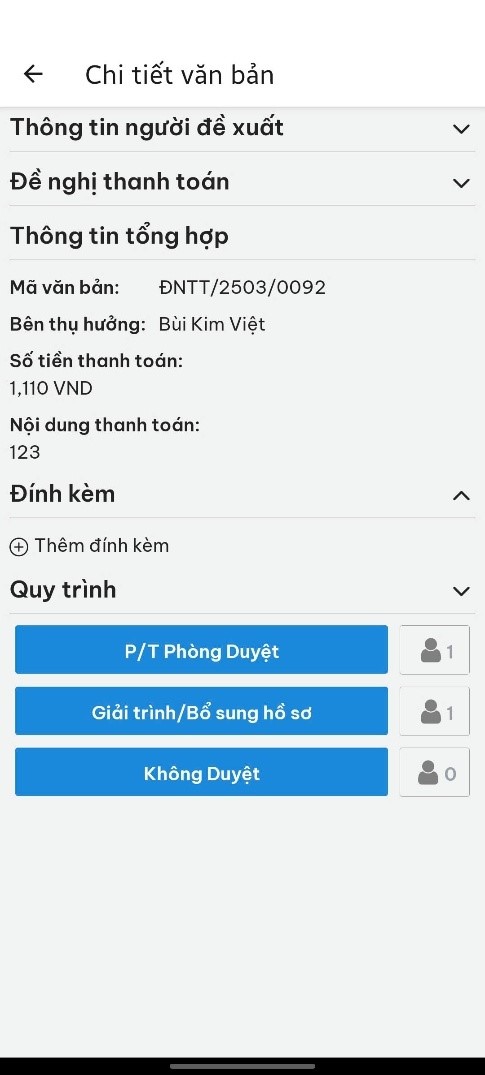
Ø 4.1. Detailed Information

Includes the proposer and the main content of the document. You can tap the arrow to expand the information.

Ø 4.2. Summary Information

Displays a summary if the document is long.

Ø 4.3. Attaching Files

You can:

  • View attached files by tapping the file name.
  • Add attachments: tap "Add Attachment" → select a file from your device → enter a description → save.

Guide to opening attached files (Video guide: Watch here .)

  • AndroidTap to open directly using any app.
  • IOS: Tap the file name → select "Notes" → save → open Notes to read the file.

To add an attachment, tap the "Add Attachment" button, select 1 file from your phone, then enter a description if any, and press save.

Note:

  • Only 1 attached file can be selected at a time.
  • Each file must not exceed 25 MB.

Ø 4.4. Processing Workflow

Displays the execution process of the document.

  • Tap on the document you want to view the workflow for.
  • Tap the arrow to expand or collapse.
  • A workflow consists of multiple stages; each stage includes: status, the employee receiving the document, execution, the employee receiving execution, comments, and confirmation date.

Ø 4.5. Actions

Each document may or may not have actions you can perform (e.g., approve, reject...). Next to each action is a button displaying the number of people who will receive the document after you perform that action.

To view the recipient list after performing an action, tap the buttons aligned with that action. For gray buttons, you can only view the recipient list; for blue buttons, you can modify this recipient list.

After modifying the recipient list, press save.

Note: Note: Each action has a fixed recipient list; if you want to add people outside this list, you need to contact support. Each action must have at least one recipient when adding people, and when there is only 1 recipient, that person cannot be deleted.

Approving documents: Tap the action to be performed to approve the document. A notification panel will appear.

IV. Document Sign-Off

After reviewing the content, you just need to tap the action to be performed, and the system will display an action confirmation window. Press Send to complete the sign-off process.

V. Conclusion

The Sea Sign application is an effective solution helping you process documents quickly at work, even when you are not present at the office. With just a few simple installation steps and operations, you can approve documents anytime, anywhere.

Install and experience Sea Sign today to enhance your work efficiency!