

Four Technology Trends Shaping the Future of Vietnam

In the era of powerful digitalization, Vietnam is transforming into a regional technology hub, serving not only as an assembly site but also as the cradle for many "Make in Vietnam" initiatives. Data has become the core driving force, reshaping how we live, work, and do business. Currently, prominent technology trends in Vietnam focus on applying Artificial Intelligence (AI), promoting domestic innovation, upgrading smart consumer devices, and strengthening its position in the global electronics supply chain.

1. Artificial Intelligence and Data Science: The Key to Transformation

Artificial intelligence (AI) and Data Science (DS) have become core driving forces in predicting market trends and optimizing production processes. The potential of AI/DS is limitless when it comes to making smart, data-driven decisions.

However, this field also faces numerous challenges, as statistics show that 80% of AI projects fail right from the initial problem definition stage. The causes of failure often stem from unclear objective setting or the lack of a structured approach for implementation. Therefore, Logical thingking and Problem-Solving Skills are core and indispensable capabilities for transforming raw data into real business value.

with a systematic approach. AI/DS professionals need to apply the 7-step process framework with a systematic approach, which includes defining the problem clearly using the 5W1H technique and finding the root cause through the 5 Whys method. Setting objectives must adhere to the SMART (Specific, Measurable, Achievable, Relevant, Time-bound) to ensure actionability and sustainable value.

Công nghệ mới và Ứng dụng: Trong lĩnh vực thị giác máy tính, Image Segmentation (phân vùng ảnh) is an important task. To solve complex problems that require high levels of detail, deep learning methods utilize kiến trúc mạng U-Net đang được ưu tiên. U-Net, với thiết kế đối xứng gồm encoder và decoder, lần đầu tiên giới thiệu skip connections in Deep Learning to minimize spatial information loss during the downsampling process. Applications of Segmentation are highly diverse, ranging from segmenting cells in medicine to detecting roads and vehicles in autonomous driving.

2. Driving the "Make in Vietnam" Initiative

The Vietnamese government and business community are actively promoting Science, Technology, Innovation, and Digital Transformation initiatives. The Ministry of Science and Technology has launched The Portal for receiving and publishing science, technology, innovation, and digital transformation products and solutions (Portal 57).

This platform not only publishes typical solutions that have been successfully deployed, but is also a place to honor and spread initiatives and improvements Technical no matter how small, reflecting the spirit of Resolution 57. The Ministry of Science and Technology plays the role of appraising the features and effectiveness of the products in order to connect and promote them to organizations, ministries, and sectors.

Representative Vietnamese enterprises: Vietnam's major technology corporations have demonstrated strong support for this platform:

• Representative FPT stated that Portal 57 is a strategic connecting platform between the Government and the technology business community.

Group Representative CMC commented that this is a practical action to bring Resolution 57 to life.

• Trí Nam Co.op assessed that Portal 57 is a useful environment that helps product owners and those in need find each other easily, quickly, and reliably.

• MISA proposed that the Ministry of Science and Technology add dossier classification criteria to make it more convenient for users to search.

3. Consumer Technology and Smart Home Appliances"

The Vietnamese market is witnessing a boom in smart devices, from home appliances to wearables, meeting the demand for improving the quality of life and sports training.

Smart home appliances and security:

Introduced smart home products include electronic rice cookers, mini projectors Beecube X2 Max Gen 3 Full HD 1080P, and smart electronic scales Eufy C20The Eufy C20 scale is integrated with advanced biometric analysis technology, measuring weight and calculating BMI with an extremely low margin of error (0.05kg), while also capable of analyzing heart rate, bone mass, and visceral fat rate.

• In the field of security, smart surveillance camera products such as Xiaomi IP WiFi 3MP C100 and Tp-Link Tapo C206 2MP attracted a lot of attention. Xiaomi's camera is equipped with AI capable of detecting human movement, minimizing false alarms, and recognizing abnormal sounds (baby crying).

Wearables and Gaming:

• Smartwatch models dedicated to sports are attracting attention, such as Amazfit T-Rex 3 Pro (with an ultra-durable design using a Grade 5 Titanium bezel and sapphire glass, along with a sensor BioTracker 6.0 PPG) và Huawei Watch GT6 46mm (with high-performance dual-band GPS, using HarmonyOS smooth experience and silicon carbon new gen for long-lasting usage).

• In gaming, the trend focuses on speed and lightweight design. An example is the gaming mouse Corsair SABRE v2 PRO Ultralight weighing only 36g, along with the ability to support Polling Rate lên tới 8000Hz and 33,000 DPI sensor

4. Strategic Position in the Global Supply Chain

Vietnam is becoming an important manufacturing and transit hub amid global trade tensions. The world's largest electronics brands, such as Apple, HP, and Dell, are requiring their Asian partners to ramp up production and shipping to air-freight products such as smartphones and laptops to the US to evade tariff strikes. Supply chains have been built in India and Southeast Asia that have been built over many years are now paying off.

with the goal of capital recovery, causing major disruptions. Although large domestic technology enterprises such as However, the US imposing high tariffs on Chinese goods has also raised concerns. Mr. Tran Huu Quyen, Chairman of VNPT Technology, warning about the possibility that Chinese electronic goods could flooding into the Vietnamese market with the goal of capital recovery, causing major disruptions. Although large domestic technology enterprises such as Viettel and VNPT assesses that US tax policies will have almost no direct impact on them; however, they still need early intervention from regulatory authorities to ensure the healthy development of the domestic market.

In summary, Vietnamese technology is developing with a focus on quality, domestic innovation, and the structured application of AI/DS. In tandem, Vietnam's role in the global supply chain is becoming increasingly strategic, demanding flexibility and the capability to respond to international market fluctuations.

Digital Marketing Strategic Plan for Agricultural Enterprises in Vietnam

Digital Marketing Strategic Plan for Agricultural Enterprises in Vietnam
The document presents the digital transformation orientation for Vietnam's agricultural sector in the 4.0 era. Content includes: market analysis, digital branding with 4 core messages (Clean – Fresh – Convenient – Sustainable), multi-channel strategy (Social Media, SEO, Content, E-commerce), along with a 6-step implementation roadmap and a KPI system for performance measurement.

This is a strategic handbook that helps Vietnamese agricultural enterprises develop sustainably and lead the market in the digital era.

In the context of Vietnam's agriculture entering a period of powerful transformation, digital marketing is no longer an option – it is an inevitable path.
The plan from SeaTek not only provides a modern customer acquisition strategy but also serves as a guiding compass to help agricultural enterprises build a strong brand, increase value, and develop sustainably in the digital era.

Algorithms 02 – Link list 

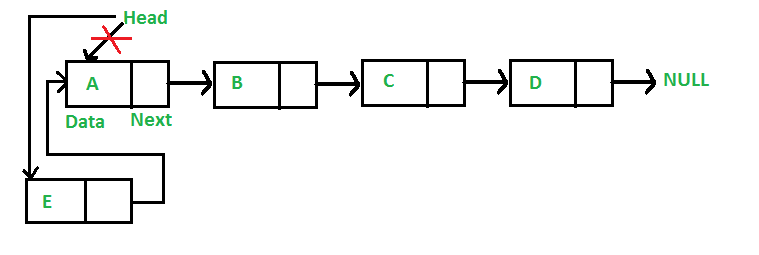
Linked List (Linked list) is one of the structured data frameworks in the installer. It is displayed from a a series of nodes, where each node stores the value (value) and a pointer (pointer) points to the next node in the list. This structure is particularly useful when working with dynamic data or performing frequent insertion and deletion operations.

Note: This article is for beginners. The author shares their self-learning process, hoping to inspire and reinforce knowledge for the community. If you already have experience, continue practicing at a higher level or try rewriting and explaining it – as this is the most effective way to memorize and train algorithmic thinking.

1. Understanding Linked Lists through a visual example.

Imagine Linked List like string ticket trên Jira or Trello – each ticket has a link “Next” leads to the next ticket.

In fact, you'll find linked lists in many places:

  • Function Undo/Redo Excel or VS Code are prime examples of this. Doubly Linked List:
    • Ctrl + Z → go backward (prev)
    • Ctrl + Y → Go to (next)
  • Web browser when you press Back or Forward — that is, you are moving in a Two-way linked list Displays browsing history.

2. Common Types of Linked Lists

Singly Linked List

Each node has only one pointer. next points to the next node.

  • Browse words head → tail But there's no turning back.
  • Advantages: simple, memory-saving, fast insertion or deletion at the beginning of the list (O(1)).
  • Disadvantage: cannot be accessed backward; to find a node previously, you have to traverse from the beginning.
  • Typical exercises: LeetCode 206 – Reverse Linked List.

Doubly Linked List

Each node has both pointers. prev and next, allowing for bidirectional browsing.

  • Browsing is possible in both directions.
  • Inserting/deleting in the middle is more convenient than a single list.
  • It takes extra memory to save. prev.
  • Caution is needed when updating the cursor to avoid incorrect pointing errors.

Circular Linked List

Last node (tail) points back to the first node (head), forming a closed loop.

  • Browsing from any node will traverse the entire list.
  • Application in round-robin scheduling or systems that require continuous loops.
  • A clear stopping condition needs to be defined to avoid infinite loops.

3. Comparing Linked Lists and Arrays

CriteriaArrayLinked List
Access by indexO(1)O(n)
Insert/Delete ElementO(n)O(1) (if there is a pointer)
MemoryFixed allocationMore dynamic and flexible.
ApplicationDB Index, Static ArrayUndo/Redo, Cache, LRU Cache

4. Featured LeetCode exercises

  • 206. Reverse Linked List → Reverse the cursor direction using three variables prevcurrnext.
  • 141. Linked List Cycle → Detect loops using two fast-slow pointers (fast–slow pointers).
  • 21. Merge Two Sorted Lists → Merge the two sorted lists, carefully pointing the pointer correctly.
  • 146. LRU Cache → Combine HashMap (O(1) lookup) and Doubly Linked List (O(1) reorder, delete).

5. Basic Python Code Examples

class Node:
    def __init__(self, val):
        self.val = val
        self.next = None

class LinkedList:
    def __init__(self):
        self.head = None

    def insert_head(self, val):
        node = Node(val)
        node.next = self.head
        self.head = node

    def insert_end(self, val):
        node = Node(val)
        if not self.head:
            self.head = node
            return
        curr = self.head
        while curr.next:
            curr = curr.next
        curr.next = node

    def print_list(self):
        curr = self.head
        while curr:
            print(curr.val, end=" -> ")
            curr = curr.next
        print("None")

6. Effective ways to learn and practice

Before you start coding, please Draw a Linked List diagram on paper.Most errors when working with Linked Lists stem from pointing the wrong cursor.pointer), so be sure to understand the direction of next and prev before running the code.

  • Focus on four groups of exercises: reverse list, detect cycle, merge lists, remove node, and LRU cache.
  • In backend/frontend interviews, you'll often be asked about the trade-off between Arrays and Linked Lists.
  • Prepare templates Node and LinkedList To code faster.
  • Always consider the time/space complexity beforehand to optimize the solution.

7. The mindset for training is important.

When practicing linked lists, start with a short list: [1 → 2 → 3 → None] or [10 → 20 → 30 → 40 → None].

With a short list, it's easy to observe the changes after each operation. insert, delete, reverseIf you encounter a pointing error, printing a small list helps in quick detection. Once your logic is solid, try a larger test case.

Additionally, please write more. helper function like print_list() or to_array() To visualize the data after each step.

8. Conclusion

  • Linked Lists are the foundation of many other data structures such as Stack, Queue, Graph, and Cache.
  • Understanding the nature of pointers is more important than memorizing formulas.
  • Draw – Simulate – Code – Optimize: that's the most effective learning cycle.

Summary: Mastering Linked Lists will give you a deeper understanding of how data operates in memory and expand your thinking to more complex structures like Trees, Graphs, Heaps, and HashMaps. Understanding the fundamentals first, then optimizing – that's the right mindset when learning algorithms.

Algorithms 01: Dynamic Programming on Graphs

This article systemizes the core nature of Dynamic Programming when applied to graph structures. I present it in clear sections to help readers grasp the key focus and approach — especially suitable for beginners or those looking to review the concept.

1. Core Idea

In classical DP problems (e.g., Fibonacci, Knapsack), states usually have a natural order from 1 to n. On graphs, the dependency relationships between nodes do not have a fixed order; therefore, it is necessary to determine an appropriate computation order to ensure that dependencies are satisfied before computing the value of a node.

Topological order is the ordering of vertices in a directed graph such that if a directed edge u → v exists, u appears before v. If the graph is a DAG (Directed Acyclic Graph), we can perform a topological sort and safely use this order for DP. If the graph contains cycles, topological sort is not applicable; in that case, alternative techniques such as DFS combined with memoization or iterative relaxation algorithms like Bellman–Ford / Floyd–Warshall are used until the values converge.

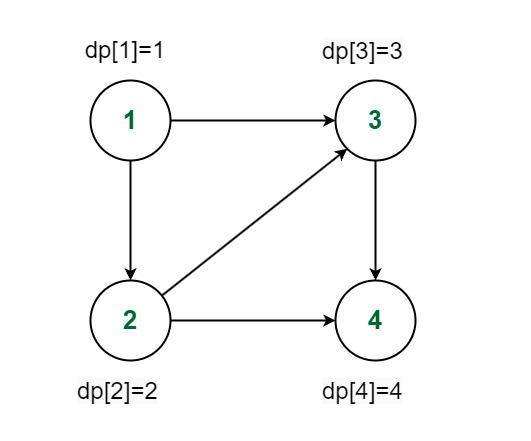
Illustrative example: to compute the value of node 4 (assuming the value is the total path from 1 to 4), we first need the results of nodes 2 and 3; to have 2 and 3, we must have the result of 1. Therefore, it is necessary to arrange the order so that each node is computed after the nodes it depends on.

ex: topo = [1, 2, 3, 4]

dp[1] = base
dp[2] = f(dp[1])
dp[3] = f(dp[1])
dp[4] = f(dp[2], dp[3])

Thus, the computation order always ensures that dependencies already have values.

2. Example: Longest Path on DAG

Problem: Given n vertices and a set of edges, find the length of the longest path on a DAG. Idea: Traverse the vertices in topological order and update the values for adjacent vertices.

For each edge u → v, perform:

dp[v] = max(dp[v], dp[u] + 1)

Pseudo code:

topo = topological_sort(graph)
dp = [0 for _ in range(n)]
for u in topo:
    for v in graph[u]:
        dp[v] = max(dp[v], dp[u] + 1)
return max(dp)

Time complexity: O(V + E) if a topological order is already available. Topo ensures that a vertex is never updated before its prerequisites have been processed.

3. When Graphs Have Cycles

If the graph contains cycles, topological sort is not applicable. Common alternatives include:

  • DFS + memoization: use DFS to compute values on demand, storing results (memo) to avoid recomputation. For problems requiring the longest path on a graph with cycles, cycles must be handled appropriately (e.g., detecting infinity or cutting cycles according to the problem requirements).
  • Bellman–Ford / Floyd–Warshall: iterative algorithms that relax edges multiple times until the values converge (or detect the existence of a negative cycle with Bellman–Ford).

DFS + memo pseudo code:

def dfs(u):
    if seen[u]:
        return dp[u]
    seen[u] = True
    dp[u] = 1 + max(dfs(v) for v in graph[u])
    return dp[u]

Bellman–Ford: iterate through all edges V-1 times, each time performing an update of the form dist[v] = min(dist[v], dist[u] + w). In essence, this is a form of iterative DP (iterative relaxation) until the values stabilize.

4. Real-World Analogy

Real-world dependency management problems accurately reflect the thinking of DP on graphs:

  • Airflow DAG: a task only runs when the tasks it depends on have completed.
  • Compiler dependency graph: module A must be compiled before module B if B depends on A.
  • Neural network forward pass: traverse the computation graph in topological order to compute the values of the nodes.

Ultimately, these are all dependency resolution.

5. Key Takeaways

  • On a DAG, prefer using topo DP with a complexity of O(V + E).
  • If the graph contains cycles, consider using DFS + memoization or iterative relaxation algorithms like Bellman–Ford.
  • The focus is not on formulas; it is on managing information flow (dependencies) and computation order.
  • DP on graphs = reuse + ordering + dependency control.

6. Related LeetCode Problems

For practice, you can refer to the following problems (from easy to medium-hard):

  • 207. Course Schedule — cycle detection + topo sort
  • 210. Course Schedule II — construct topo order
  • 329. Longest Increasing Path in a Matrix — DP on an implicit graph in a grid
  • 1514. Path with Maximum Probability — DP combined with Dijkstra
  • 787. Cheapest Flights Within K Stops — a variant of Bellman–Ford

7. Personal Reflection

I used to understand DP as a rigid set of state transition formulas. After diving deeper, I realized that the essence of DP is managing information flow within a dependency network. Graphs only make the concept more abstract, but the principle remains the same: solve the simple parts first, store the results, and then use them to compute the more complex parts.

Once you grasp this principle, algorithms like Bellman–Ford, Floyd–Warshall, or topo DP become much more intuitive. A useful habit: draw the dependency graph before coding and experiment with a small example (4–5 vertices) to observe the order and how values propagate.

Practical Principles:

  • Understand the computation flow (simulate flow) before implementing code — Understand > Memorize.
  • DP = reuse + ordering + dependency management — from there, you can reconstruct the algorithm without having to memorize formulas.
  • If there are cycles, do not force a topo sort; switch to an iterative update method like Bellman–Ford and continue to relax until stable.
  • Always clearly identify 'who depends on whom' — visualization helps to quickly grasp dependencies.
  • Start from the base case; think forward (past → future) or backward (goal → start) depending on the problem.
  • If you find yourself computing the same value repeatedly — use memoization; double-check boundaries and base cases to avoid common errors.

Ghi chú: Đây là chia sẻ từ góc nhìn người bắt đầu nhằm giúp người học hệ thống lại kiến thức. Việc thực hành và giải nhiều bài sẽ giúp nâng cấp khả năng làm chủ các biến thể nâng cao hơn.